Drones Unleashed: The Power Duo Scaling Time and Distance
November 19, 2025
TEAL and Hextronics, with seamless connectivity and rapid battery swapping (respectively), have taken time and distance to a whole new level for autonomous missions. In Episode 96 of “Dawn of Autonomy,” Robb Monkman, Chief Marketing Officer of TEAL, and Curtis Lary, Founder and CEO of Hextronics, two entrepreneurs with a shared focus on reliability, flexibility and the practical needs of autonomous technology deployments, talked about their companies, products and their unique partnership.
When Entrepreneurial Drive Meets Real-World Need
Monkman, whose career spans two decades in Business-to-Business Software-as-a-Service (B2B SaaS) and connectivity, launched his first business in college and has led innovation in hospitality Internet of Things (IoT) and Electric Vehicle (EV) charging. Four years ago, he became CMO at Seattle-based TEAL. There he joined company co-founder Robby Hamblet, who witnessed firsthand the limitations of traditional, single-carrier connectivity within the automotive sector. Hamblet and co-founder and Chief Business Officer Michael Johnston recognized the urgent demand for multi-carrier, multi-network redundancy and that such need would quickly expand from autos to drones, smart cities, healthcare and beyond.
Curtis Lary, a mechanical engineer and serial entrepreneur, started Hextronics in Miami after years of hands-on work in robotics and automation. “I always had this dream of drones flying around providing services… but it only works if the drones have somewhere to go and can keep flying without human intervention,” Lary reflected. The company’s inception was spurred by feedback from drone pilots frustrated with the human bottleneck of manual battery swapping. Lary recalled, “They said, ‘If you can make a little box that houses this drone and swaps batteries, we’ll buy it.’ So I said, ‘Watch your tongue, because I’m going to make them.’” The first Hextronics units emerged from his garage and quickly found buyers worldwide, thanks to their autonomy-first design for persistent operations. Today, Hextronics serves customers in 25+ countries and operates a state-of-the-art factory in Miami.
TEAL’s NOS: Reliability for Autonomous Systems
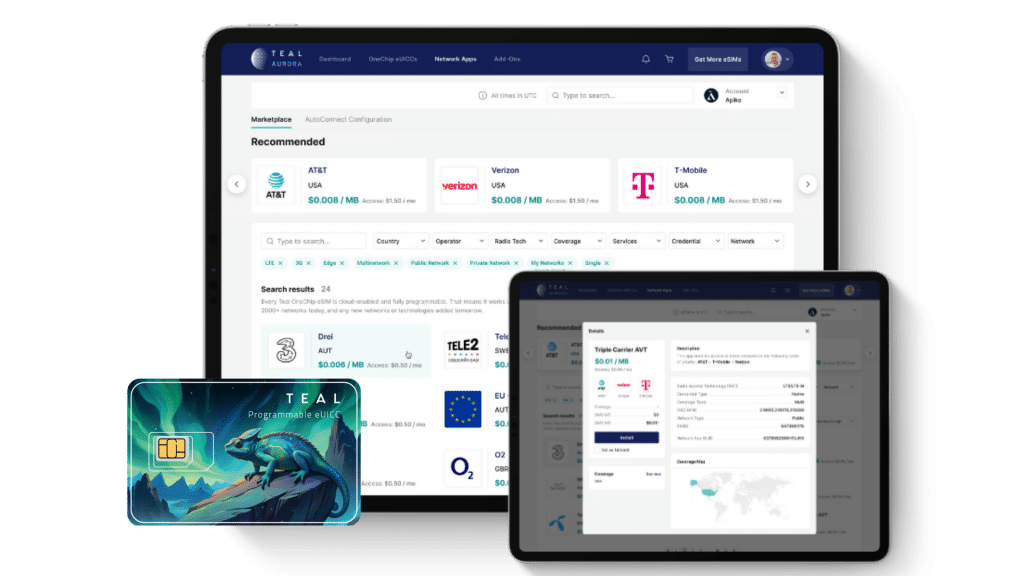
TEAL’s core offering, a cloud-based Network Orchestration Service (NOS), pairs patented Global System for Mobile Communications Association–certified embedded Subscriber Identity Module (GSMA-certified eSIM) technology with a single, intuitive dashboard. “At the end of the day, what we do in plain English is allow devices like drones to connect onto any network globally in 196 countries and have the ability to fall back to a primary network, if needed,” Monkman emphasized. This redundancy is essential for autonomous missions. He continued, “Mission-critical solutions need mission-critical connectivity. You can’t have a single source of failure.” TEAL’s NOS lets users switch networks remotely. This capability removes the need for physical SIM swaps or tangled multi-carrier contracts.
TEAL’s NOS interface, a “single pane of glass,” streamlines network management for entire fleets. Operators monitor SIM status, set fallback networks and can deploy anywhere, whether for BVLOS flights, mobile robotics or smart infrastructure. TEAL’s “BYOC” (Bring Your Own Carrier) approach supports integration with existing clients’ pre-existing mobile network operator (MNO) contracts, which enables the supercharging fleets without forcing exclusivity. Monkman noted, “Reliable, redundant connectivity is a massive gap we’re looking to fill.”
Hextronics Hardware: Universal, Atlas, and Hexair
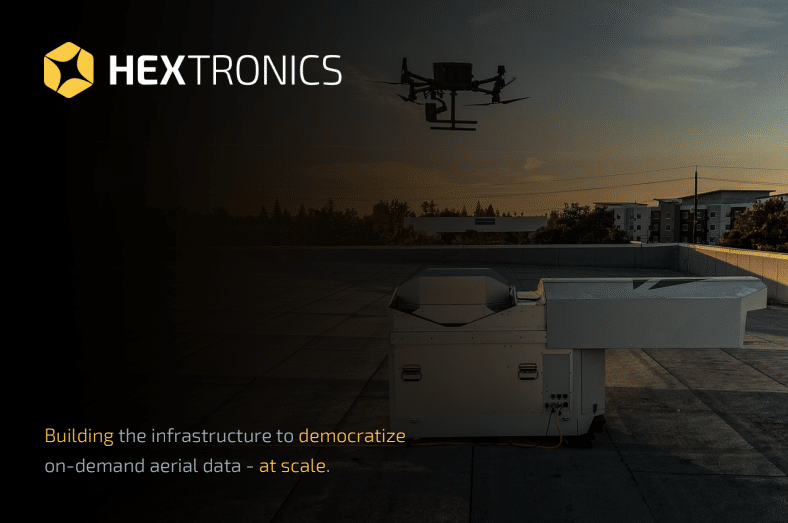
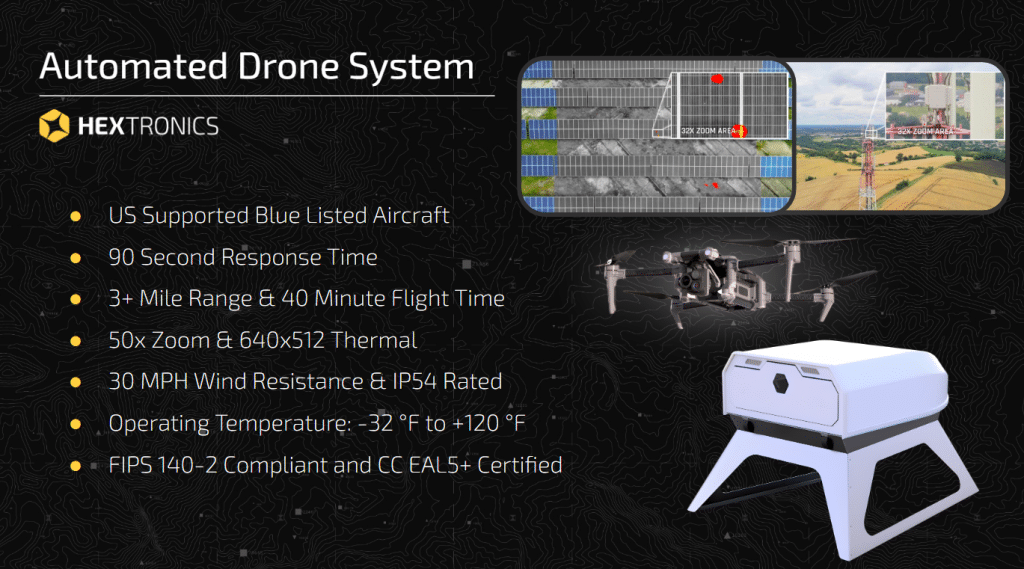
Hextronics’ portfolio includes multiple drone docking stations engineered for compatibility and enduranceHextronics solves the great time barrier of drone operations: the need for manual battery swaps. Lary’s team designs, builds, and deploys fully automated battery-swapping drone stations, allowing drones to keep flying with near-zero downtime. The secret is a modular, robotically operated platform capable of operating in harsh environments and extending battery life while ensuring safety and reliability. Products include:
- Universal Station: Small, versatile, and compatible with leading platforms like DJI, Parro, and Anzu, it supports highly modular operations and rapidly swaps batteries for persistent flight, especially in mapping and security applications. With precision landing, robust Heating, Ventilation, and Air Conditioning (HVAC) and support for cellular-enabled drones, the Universal enables drones to fly more and stay mission-ready.
- Atlas Station: Built for larger aircraft (e.g., DJI M300/350 RTK) and heavy-payload missions, Atlas features 8 battery slots and can swap batteries in under 90 seconds. Its IP55-rated housing withstands extreme environments, while advanced smart charging ensures longevity. Designed for industrial inspection and emergency response, Atlas excels in tough climates from Arizona to Alaska.
- Hexair Software: The company’s newest cockpit software platform, Hexair interfaces with multiple drone types. Its API-centric architecture delivers telemetry, live video, and remote precision landing controls. By abstracting complex docking integrations, Hexair empowers users to operate fleets at scale and integrate high-level mission commands, including future AI-driven “model context protocols” (MCPs) for automated data gathering.
Mission Enablers: Unleashing Time and Distance
TEAL and Hextronics have created a complementary partnership where connectivity and downtime reduction converge. Previously, drones were limited to a two-mile leash by radio links. Now with TEAL’s global SIMs, drones use cellular to leapfrog stations and with Hextronics battery swapping stations, they can stay airborne. This allows customers to cover pipelines and infrastructure in 100-mile segments with near-zero downtime. Lary explained, “Once you bring cellular into the mix… drones can hop from station to station, survey an entire rail track, and keep hopping… With battery swapping, downtime’s really limited.”
This team-up unlocks massive time and distance value. Remote operators in command centers can now manage fleets from anywhere, swap batteries from afar and maintain connectivity across continents. This fusion opens up new markets:
- Energy: Persistent inspection of pipelines, solar farms, and wind turbines is now possible without human intervention, reducing downtime and improving ROI.
- Construction: Hextronics can increase productivity by up to 50% on sites where rapid turnarounds are crucial, while TEAL ensures seamless data flows in the background, even in challenging network footprints.
- Public Safety: Drone-as-First-Responder (DFR) missions for police, fire, and emergency services depend on Hextronics’ rapid turnaround, made virtually frictionless by TEAL’s multi-network failover and centralized management.
The combined solution supports customers like Flock Safety, Chevron, and U.S. Customs and Border Protection.
Looking Ahead: More Freedom, More Flexibility
TEAL and Hextronics are already doing great things, both individually and together. They also have big plans for the coming year.
In 2026, TEAL will be potentially looking to expand support for satellite profiles (Starlink, Viasat, Iridium), to make NOS “technology agnostic.” Monkman highlighted new certifications like SGP32 and the companies evolving the BYOC philosophy, will continue to allow customers more freedom to blend their preferred carriers with TEAL’s redundancy tools.
Lary predicts further growth in Hexair capabilities. “I’m excited to see applications of this data capture capability… Drones being physical agents of the world to check assets, inspect infrastructure, and build a world we can maintain at a higher cadence and cost savings,” he said.
The Road to 2026, Plus Poignant Advice from the Experts
Looking ahead, TEAL is doubling down on platform-agnostic network orchestration. Monkman said, “We just started giving our customers more and more freedom of choice.” The company supports the new SGP.32 eSIM standard and further enhancements to BYOC, ensuring customers can supercharge their existing carrier agreements without vendor lock-in. Anticipating the growing overlap with satellite providers, TEAL is investing in technology-agnostic orchestration, so customers can blend cellular, satellite, or RF as each mission requires. “Connectivity should not be an afterthought,” Monkman emphasized. “There’s a lot of pain that can be reduced if you think about connectivity ahead of time.”
Hextronics, meanwhile, is focused on deepening integration between Hexair and emerging AI-driven data collection protocols. Lary envisions a world where “drones are the physical agents of the world… to check and see if something was completed or not,” providing high-value, high-frequency inspection and data capture across the built and natural environments. The roadmap includes adding MCP to Hexair to enable seamless, automated data collection missions driven by smart software and emerging enterprise needs.
It’s no surprise that Lary champions mission value. “Plan to get the most value out of your mission. Think about all the data you can capture, not just the initial scope,” he urged. That will maximize the value of your drone and autonomy stack, and quicker with battery swapping and robust software.”
As the autonomy market moves forward, expect to see TEAL and Hextronics continue to serve as mission enablers for a new phase of deployment, where drones are truly unleashed to achieve longer, faster and more informative missions than ever before.
- Podcast
Related News